
Updated: October 2026
How do you recognize rats in your home and on your property?
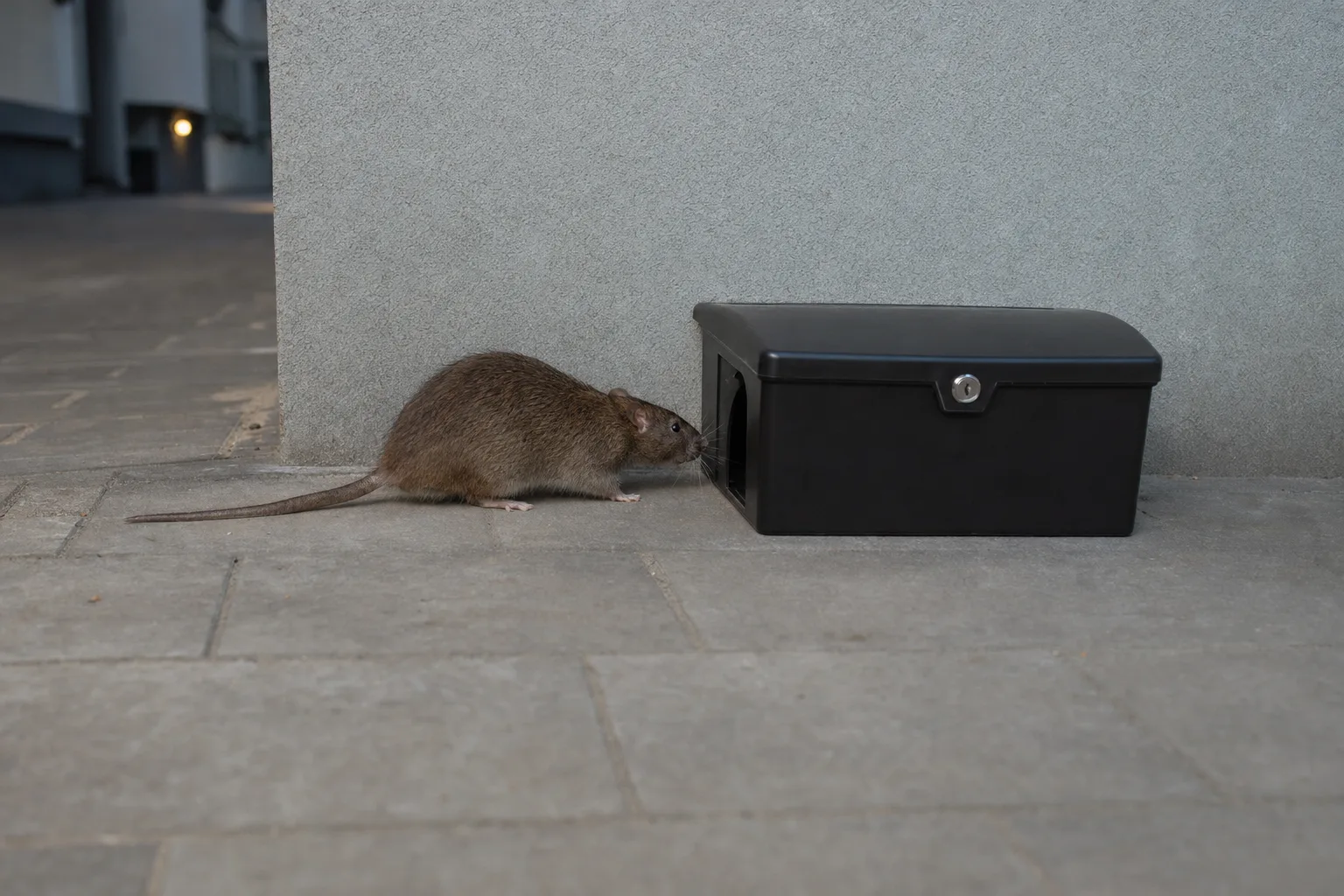
In Poland, the problem is almost always the brown rat (Norway rat, Rattus norvegicus) — a large rodent with a body about 20–25 cm long and a thick, scaly tail slightly shorter than its body. It is active mainly at night and very cautious, so you usually see signs of its presence first and only later the animal itself. A rat out in the open during the day is often a sign that the population is already large.
Mouse or rat — how do you tell them apart by the droppings?
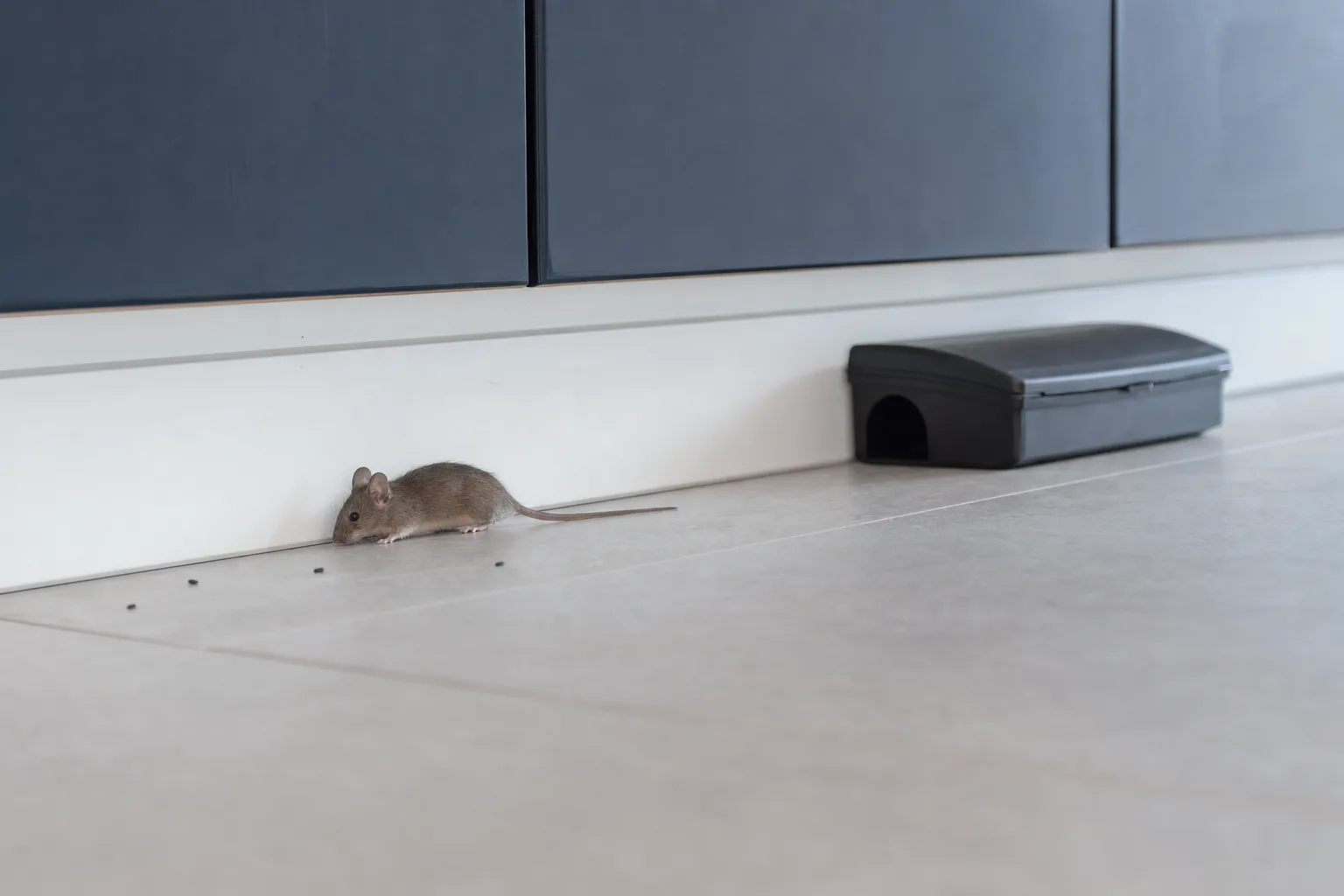
- House mouse — small droppings, about 3–6 mm, like grains of rice, scattered in many places; coin-sized holes. See mouse control.
- Marten — noise in the attic, droppings with bits of fruit and fur, chewed wires in the car — that’s a different problem, most likely a marten.
- Voles and water voles — mounds and burrows in the garden, but no signs in the building; they usually don’t come into the house.
- Not sure? — send us a photo of the droppings or gnaw marks on WhatsApp — it can usually be identified right away.
What risks do rats pose?
Rats can carry diseases that are dangerous to humans, including leptospirosis and salmonellosis — through urine, droppings and contaminated food. On top of that comes property damage: chewed insulation on electrical wiring is a real risk of a short circuit and fire, and damaged building insulation, sacks of animal feed or warehouse stock often cost more than the rodent control itself.
The second problem is how fast they breed. A female brown rat is pregnant for about 21–24 days, usually gives birth to 6–12 young and, in good conditions, can have several litters a year. After a few months the young start breeding themselves, so a few rats by the garbage area can turn into a colony with burrows under the whole building in a single season.
- Gestation
- about 21–24 days
- Young per litter
- usually 6–12
- Litters per year
- several, in good conditions even 5 or more
- Foraging range
- usually a few dozen meters from the nest
How to get rid of rats — rodent control step by step
Rats are wary of new objects and quickly learn to avoid places where something harmed them. That’s why effective rodent control isn’t about “scattering poison” — it’s a planned layout of bait stations along their paths, regular follow-up checks and removing the cause: access to food and ways into the building.
We use only rodenticides and biocides authorized for sale in Poland and the EU, as ready-made baits placed in lockable bait stations. Most baits contain anticoagulants, which act with a delay of several days — the rat doesn’t link the food to the poisoning and doesn’t warn the rest of the colony. You can read more about what works and what’s a myth in the article rat poisons — facts and myths.
- Initial visit and inspectionWe look for burrows, trails, droppings and entry points into the building, and assess the scale of the problem and the food source.
- Placing the bait stationsWe place lockable bait stations along the rats’ routes — by walls, in the basement, near the garbage area, on the property.
- Station mapWe record where the stations are placed and which products were used.
- Follow-up visitsEvery 7–14 days we check how much bait has been taken, top it up and, if needed, move the stations.
- Sealing and recommendationsWe point out the gaps, grates and pipe entry points that need sealing, as well as changes to make around the garbage area and the compost bin.
How long does it take to get rid of rats, and how many visits are needed?
Usually an initial visit and 2–3 follow-up visits every 7–14 days, so about 3–6 weeks. Anticoagulant baits act with a delay of several days, and rats approach new stations cautiously — so it takes time and repeated bait top-ups until the whole colony stops feeding, including the young that are only just leaving the nest.
With a few rats in a garage or shed, a shorter series is usually enough. With a colony burrowed under the building or on a large property, there may be more follow-up checks. What decides when we finish is whether the bait has stopped disappearing and no new signs are appearing.
How to prepare your home and property for rodent control
- Store food, pet food and animal feed in sealed, hard containers — a rat will choose easier food over the bait.
- Don’t leave pet food out overnight, and don’t throw food scraps on the compost.
- Keep trash cans closed and clean up around the garbage area.
- Don’t fill in the burrows before the visit — they show us where to place the stations.
- Don’t put out your own loose poison — it makes it harder to judge how much bait is being taken and is dangerous to dogs and cats.
- Make sure we can get into the basement, garage, attic and utility spaces.
What to do after the bait stations are placed
- Don’t move or open the stations — rats avoid objects that have changed position.
- Note where you see new droppings or signs, and tell us at the follow-up check.
- Wearing gloves, put dead rodents in a double bag and let us know — don’t throw them on the compost.
- Once the series is finished, seal the spots we pointed out: steel mesh, screens over drain grates, sealed pipe entry points.
- Keep the garbage area and animal feed tidy — it’s the best protection against rats coming back.
How much does rat control cost in Warsaw?
The price of rodent control depends on the type of property, its area, the number of bait stations and the number of follow-up visits. We give you the price before we arrive.
| Apartment / basementinitial visit + follow-up checks | quote before the visit |
|---|---|
| Single-family house with a yard | quote before the visit |
| Apartment building / housing associationbasements, garbage area, grounds around the building | quote before the visit |
| Commercial space / business | custom quote |
For comparison: according to kb.pl, the average cost of rat control in Warsaw is about PLN 497 including VAT.
Guarantee — what if the rats come back?
Rats can come back from neighboring properties, the sewers or green areas if they still have food and a way into the building — that’s why we don’t promise they’ll never appear again. If you see new signs after the series is complete, call us — on the next visit we’ll check where they’re coming from and point out what else needs sealing. For apartment buildings and housing associations, we help coordinate the work with the property manager, because rodent control in just one basement is rarely enough.
Customer reviews
Average company rating: 5.0 / 5 from 145 reviews (Google 93, Oferteo 37, Fixly 15). The reviews come from the company’s profiles on these sites. All reviews
Frequently asked questions about rats and rodent control
How much does rodent control for a house cost?
It depends on the size of the property, the number of bait stations and follow-up visits — we give you a free quote before we arrive. According to kb.pl, the average cost of rat control in Warsaw is about PLN 497 including VAT.
How long does it take to get rid of rats?
Usually 3–6 weeks: an initial visit and 2–3 follow-up checks every 7–14 days. The baits act with a delay of several days, and rats approach the stations cautiously.
Rats in the sewer or toilet — what should you do?
Close the toilet lid and weigh it down, don’t try to catch the rat yourself, and call us or the building manager. The problem usually involves the whole drain stack or the sewer connection, so we point out safeguards such as backflow valves.
Who is responsible for rodent control in an apartment building or housing association?
The property manager or the housing association is responsible for common areas — basements, the garbage area, the grounds around the building — and many municipalities require periodic rodent control.
Is rat poison safe for dogs and cats?
The poison itself isn’t safe, which is why we place it only in lockable bait stations that animals can’t get into. If you suspect your dog has eaten bait, go to the vet right away — anticoagulants have an antidote (vitamin K).
What about dead rodents?
During follow-up checks we remove any dead rats we find and hand them over for disposal. If you find them yourself, wear gloves, put them in a double bag and let us know.
Mouse or rat — how can you tell by the droppings?
Rat droppings are about 1–2 cm long and lie in clusters; mouse droppings are small, about 3–6 mm, like grains of rice, and scattered in many places.
 Mice
 German and Oriental cockroaches
 Ants